Loading... Please wait...
Categories
- 500 series modules
- Cables
- Channel Strips
- Clocks
- Compressors
- Control Surfaces
- Digital Converters
- DIs Direct Boxes
- Effects
- EQs
- Guitar Amps
- Headphones
- Keyboards /midi modules
- Live Sound
- Microphones
- Mixers / Summers
- Monitor Controller
- monitors
- pedals
- Pianos
- Power Strips and Conditioners
- Preamps
- Software
- Studio Tools
 Products
-
 $1,650.00
 -
 $2,349.00
 -
 $3,287.00
 -
 $4,175.00
 -
 $3,569.00

Our Newsletter
- Home
- Microphones
- Townsend Labs L22 Sphere Microphone
Townsend Labs L22 Sphere Microphone


Sorry but this item is currently unavailable.
Please check back at a later stage.
Product Description
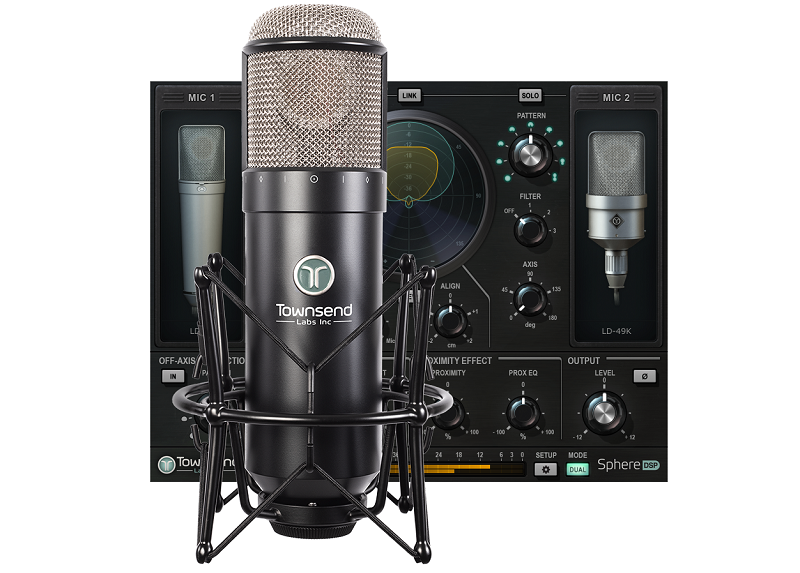
Over the past couple days, I’ve been spending some quality time with the new Townsend Labs microphone system, the Sphere L22. As with any other mic modeling system, I was a bit skeptical going into the demo. I’ve been lucky enough to use all the real versions of the microphones modeled on countless recordings across all genres of music over the last 10 years. I must say, the Townsend Labs Sphere L22 is the real deal.
Right off the bat, I was blown away by the natural sound of the microphone without any processing happening. By itself, it has a very wide frequency range, a lot of depth in the low end, a nice presence in the higher frequencies and it can handle up to 140dB of SPL.
The microphone is built really well. Some other microphone modelers feel cheap when you are holding them, but the Townsend Labs feels like a high quality microphone similar to a Neumann U47, and comes with a very nice shock mount, road ready case, felt bag, and heavy duty threaded clip if no shock mount is needed.
The power of this microphone lies in the included Sphere DSP plug-in (UAD, VST, AU, AAX Native). The plug-in accurately models the response of a wide range of microphones, including the transient response, harmonics, proximity effect, and three dimensional polar response. Choose between the industry's best mics such as the Neumann U47, Neumann M49, Neumann U67, Neumann U87, AKG C12, Telefunken 251, AKG 451, Cole 4038, and Shure SM57, as well as Townsend mic models.
One of the greatest features of the L22 that sets it apart from its competitors is the ability to change the microphone, polar pattern, filters, axis position to the sound source and proximity effect after you have recorded the source. This gives you endless options to shape the sound, no matter where the mix goes. Vocal tone not working? Easily switch the microphone that best fits the song. Not enough low end in the guitar? Add more proximity effect to fill in the low end. Even better, every parameter inside the plug-in can be automated, so you could change these settings throughout the song if desired.
I was messing around with changing the axis position of the mic during a breakdown and the effect I was getting was really cool. The only way to do that in a studio environment would be walking the mic around the speaker cabinet while recording (which I’ve done), but usually results in some kind of room noise and the inability to hear the sweet spots. With the L22, if you mess up by going too far one way or another, simply redo the automation.