 Loading... Please wait...
Categories
- 500 series modules
- Cables
- Channel Strips
- Clocks
- Compressors
- Control Surfaces
- Digital Converters
- DIs Direct Boxes
- Effects
- EQs
- Guitar Amps
- Headphones
- Keyboards /midi modules
- Live Sound
- Microphones
- Mixers / Summers
- Monitor Controller
- monitors
- pedals
- Pianos
- Power Strips and Conditioners
- Preamps
- Software
- Studio Tools
 Products
-
 $1,650.00
 -
 $2,349.00
 -
 $3,287.00
 -
 $4,175.00
 -
 $3,569.00

Our Newsletter
- Home
- Mixers / Summers
- Fredenstein MixCube 8X2 Analog Mixer with recall and USB
Fredenstein MixCube 8X2 Analog Mixer with recall and USB


Sorry but this item is currently unavailable.
Please check back at a later stage.
Product Description
The Fredenstein MixCube is a digital controlled stereo analog mixer that may be configured as 8 channel, 16 channel, 24 channel or 32 channel. Each channel has gain control in 1⁄2 dB steps, pan control in 19 steps, mute and solo. The final mix also has gain control in 1⁄2 dB steps, balance (pan) control in 19 steps and mute. Plus there are 4 “fader groups” that can control user assigned sets of channels that has gain, mute and solo functions.
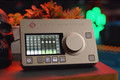
The Fredenstein MixCube is only 16cm (6.5”) x 16cm x 16cm in size. The front panel includes a 11cm (4.3”) 480 x 272 pixel color TFT display to show settings. There are 3 rotary encoders and 3 buttons on the front panel. One encoder is used to select the channel to be adjusted while the other two are used to adjust LEVEL and PAN, and buttons provide instant MUTE and SOLO functions. The third button is used to select the final MIX output which can then be adjusted for LEVEL, BALANCE (PAN) and MUTE. The graphics display also has a high resolution output level meter.
The MixCube features fully balanced summing amps. This helps achieve the unusually high +28 dBu maximum input and output levels and helps minimize noise and distortion. There are 4 discrete high quality op-amps used as line drivers (one for each phase x two channels). There are only effectively 2 capacitors in the signal path and no transformers
Input connectors are DSUB 25 with 8 balanced signals on each connector. They follow the AES59 standard as used originally used by Tascam and Digidesign. Output connectors are XLR3 male.
The MixCube can be remote controlled with MIDI or USB. This allows the MixCube to be controlled with standard MIDI Fader Controllers, including some low cost controllers with moving faders that shift the faders in response to changes in MixCube settings. For example an 8 channel controller can be used with a 32 channel MixCube and as you access different sets of 8 channels, the controller will shift the fader positions to represent this set of channels.
