 Loading... Please wait...

Categories
- 500 series modules
- Cables
- Channel Strips
- Clocks
- Compressors
- Control Surfaces
- Digital Converters
- DIs Direct Boxes
- Effects
- EQs
- Guitar Amps
- Headphones
- Keyboards /midi modules
- Live Sound
- Microphones
- Mixers / Summers
- Monitor Controller
- monitors
- pedals
- Pianos
- Power Strips and Conditioners
- Preamps
- Software
- Studio Tools
 Products
-
 $10,900.00
-
 $12,900.00
-
 $649.00
-
 $1,650.00
-
 $2,349.00

Our Newsletter
DW Fearn VT-5M Mastering Equalizer


Product Description
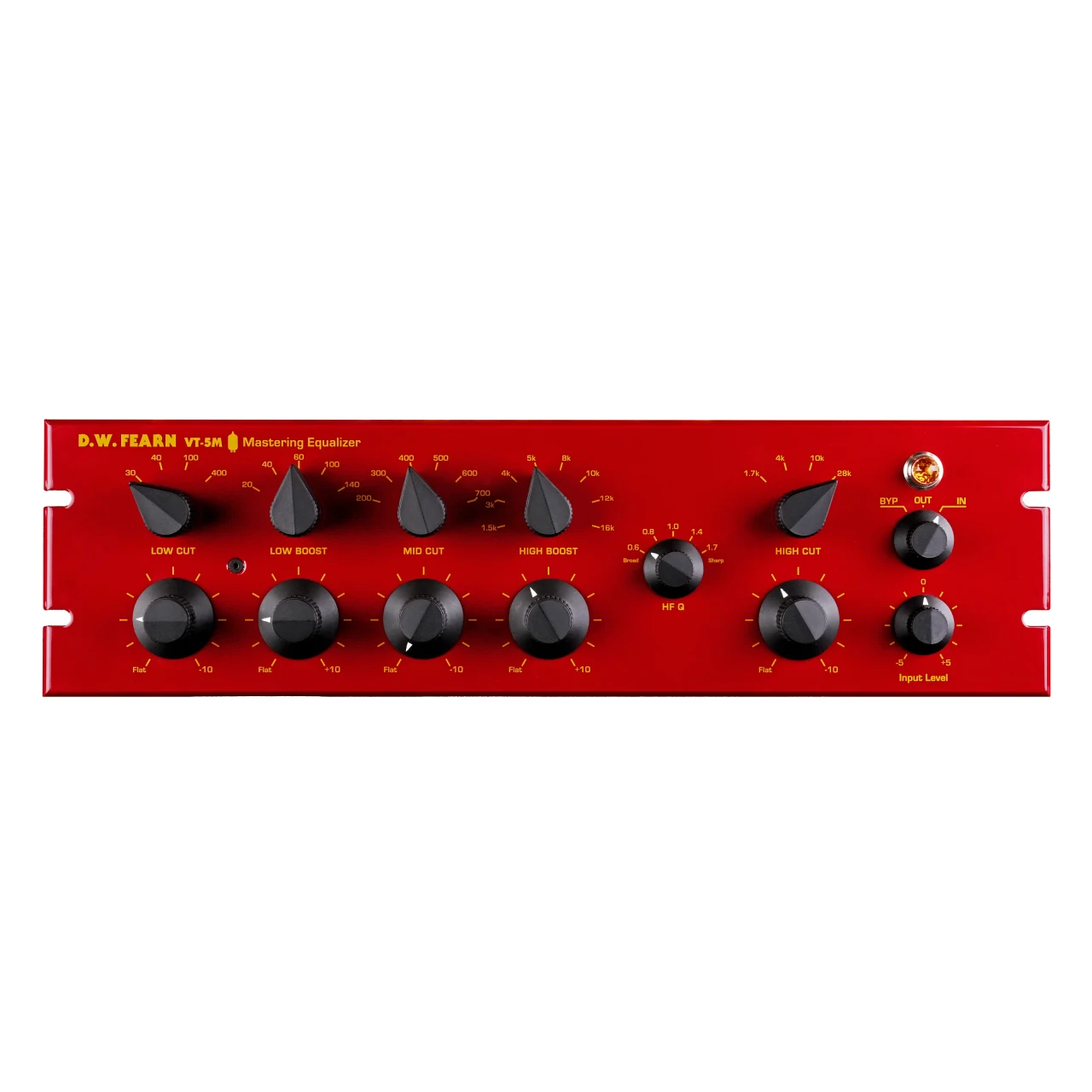
D.W. Fearn VT-5M Mastering Equalizer
The VT-5M Mastering Equalizer delivers an uncompromising, hand-crafted signal path. Built without compromises, the VT-5M is designed around impedance-matched tube amplification and a dedicated passive LC topology to bring effortless musicality and signature frequency shaping to stereo mixes or individual tracks.
Features
-
Frequency response: +/- 0.2 dB 20 Hz to 20 kHz
-
THD: less than 0.10%
-
Signal-to-Noise: better than 80 dB
(All controls are independent and can be used in any combination)
-
Low Cut at 30, 40, 100, or 400 Hz, 0 to -10 dB shelving in 1 dB steps
-
Low Boost at 20, 40, 60, 100, or 140 Hz, 0 to 10 dB shelving in 1 dB steps
-
Mid Cut at 200, 300, 400, 500, 600, or 700 Hz, 0 to -10 dB in 1 dB steps
-
High Boost at 1.5, 3, 4, 5, 8, 10, 12, or 16 kHz, 0 to 10 dB in 1 dB steps
-
High Bandwidth Q of 0.6, 0.8, 1.0, 1.4, or 1.7
-
High Frequency Cut at 1.7, 4, 10, or 28 kHz, 0 to -10 dB shelving in 1 dB steps
-
Gain adjustable from -5 to +5 dB, referenced to +4 dBm, in 1 dB steps
NOTE: Frequency is specified in cycles per second (cps) or kilocycles per second (kc). These units correspond to Hz and kHz respectively. Measurements made with -50 dBm input and 50 dB gain in a 22 cps to 22 kc bandwidth.
-
Specifications
-
Input 600 ohms
-
Input Load Impedance 40k ohms
-
Minimum Input Level -20 dBm nominal
-
Maximum Input Level @ 20 cps +25 dB 0 dB
-
Gain ± 0.5 dB 20 cps to 20 kc -3dB@0.5cps&80 kc
-
Frequency Response <0.10% 20 cps to 20 kc
-
Intermodulation Distortion SMPTE: <0.80%
-
Signal to Noise Ratio 82 dB minimum low-Z, transformer balanced
-
Maximum output +22 dBm into bridging input balanced or unbalanced
-
Power Requirements 115 or 230 VAC 50/60Hz, 85 W
-
Dimensions 19” (48.5 cm) W 5.25” (13.5 cm) H 9” (23 cm) D
-
Weight 24 lbs (11 kg)
-
True hard-wire bypass
-
